What Determines the Properties of Each Family on the Periodic Table of Elements
Chapter 2. Atoms, Molecules, and Ions
2.five The Periodic Table
Learning Objectives
By the end of this section, you will be able to:
- State the periodic law and explain the organization of elements in the periodic table
- Predict the general properties of elements based on their location inside the periodic table
- Identify metals, nonmetals, and metalloids by their backdrop and/or location on the periodic table
Every bit early on chemists worked to purify ores and discovered more than elements, they realized that various elements could be grouped together by their similar chemical behaviors. One such grouping includes lithium (Li), sodium (Na), and potassium (K): These elements all are shiny, conduct rut and electricity well, and have similar chemical backdrop. A 2d grouping includes calcium (Ca), strontium (Sr), and barium (Ba), which likewise are shiny, practiced conductors of estrus and electricity, and take chemical backdrop in mutual. However, the specific properties of these two groupings are notably different from each other. For case: Li, Na, and M are much more reactive than are Ca, Sr, and Ba; Li, Na, and K form compounds with oxygen in a ratio of 2 of their atoms to i oxygen atom, whereas Ca, Sr, and Ba form compounds with one of their atoms to i oxygen cantlet. Fluorine (F), chlorine (Cl), bromine (Br), and iodine (I) also showroom similar properties to each other, merely these properties are drastically different from those of any of the elements higher up.
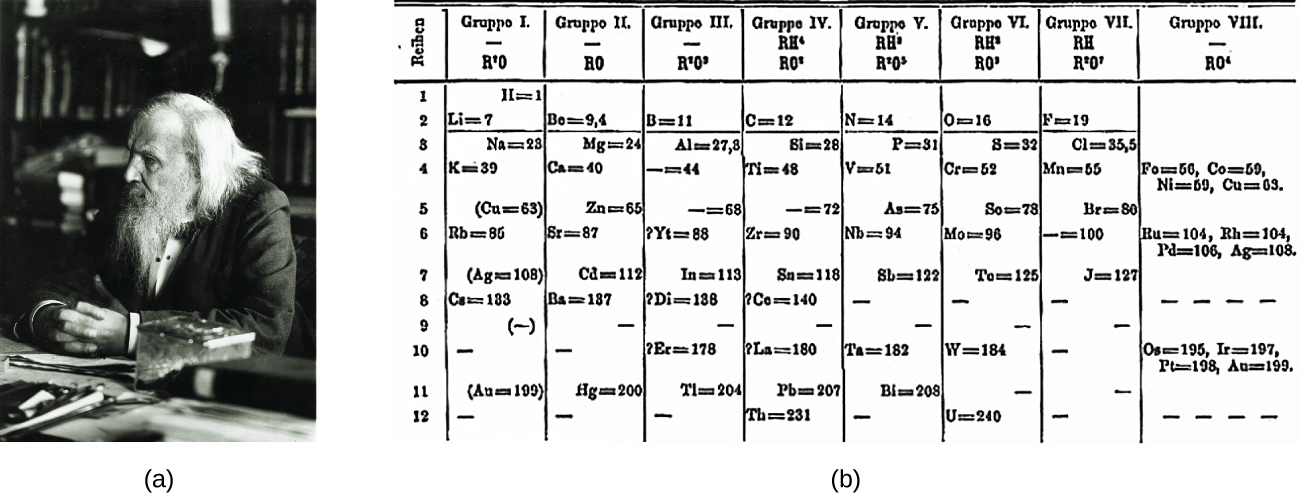
Dimitri Mendeleev in Russia (1869) and Lothar Meyer in Federal republic of germany (1870) independently recognized that there was a periodic relationship amid the properties of the elements known at that time. Both published tables with the elements arranged according to increasing atomic mass. Only Mendeleev went one step further than Meyer: He used his table to predict the existence of elements that would have the properties similar to aluminum and silicon, but were yet unknown. The discoveries of gallium (1875) and germanium (1886) provided great support for Mendeleev'due south work. Although Mendeleev and Meyer had a long dispute over priority, Mendeleev'due south contributions to the development of the periodic tabular array are now more widely recognized (Figure one).
By the twentieth century, it became apparent that the periodic relationship involved atomic numbers rather than atomic masses. The modern statement of this relationship, the periodic law, is as follows: the properties of the elements are periodic functions of their atomic numbers. A modern periodic table arranges the elements in increasing order of their diminutive numbers and groups atoms with similar properties in the same vertical column (Figure 2). Each box represents an element and contains its diminutive number, symbol, boilerplate atomic mass, and (sometimes) proper noun. The elements are arranged in seven horizontal rows, chosen periods or series, and 18 vertical columns, called groups. Groups are labeled at the top of each column. In the Usa, the labels traditionally were numerals with majuscule letters. Nevertheless, IUPAC recommends that the numbers one through 18 be used, and these labels are more than common. For the table to fit on a unmarried page, parts of two of the rows, a total of 14 columns, are usually written below the main body of the tabular array.
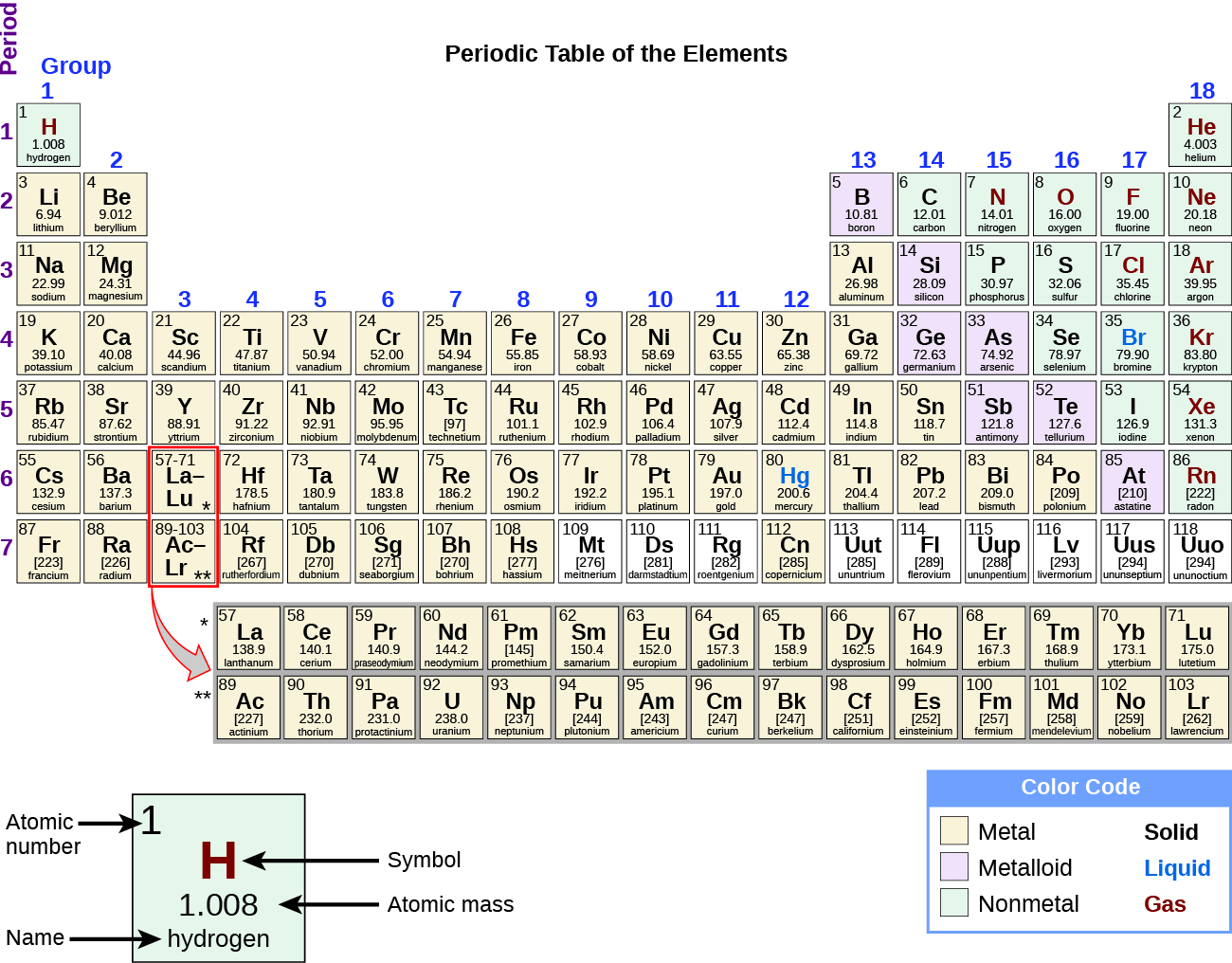
Many elements differ dramatically in their chemic and physical properties, but some elements are like in their behaviors. For case, many elements appear shiny, are malleable (able to be deformed without breaking) and ductile (can be fatigued into wires), and comport heat and electricity well. Other elements are not shiny, malleable, or ductile, and are poor conductors of heat and electricity. We tin sort the elements into large classes with common backdrop: metals (elements that are shiny, malleable, good conductors of heat and electricity—shaded yellow); nonmetals (elements that appear dull, poor conductors of heat and electricity—shaded green); and metalloids (elements that comport oestrus and electricity moderately well, and possess some properties of metals and some backdrop of nonmetals—shaded purple).
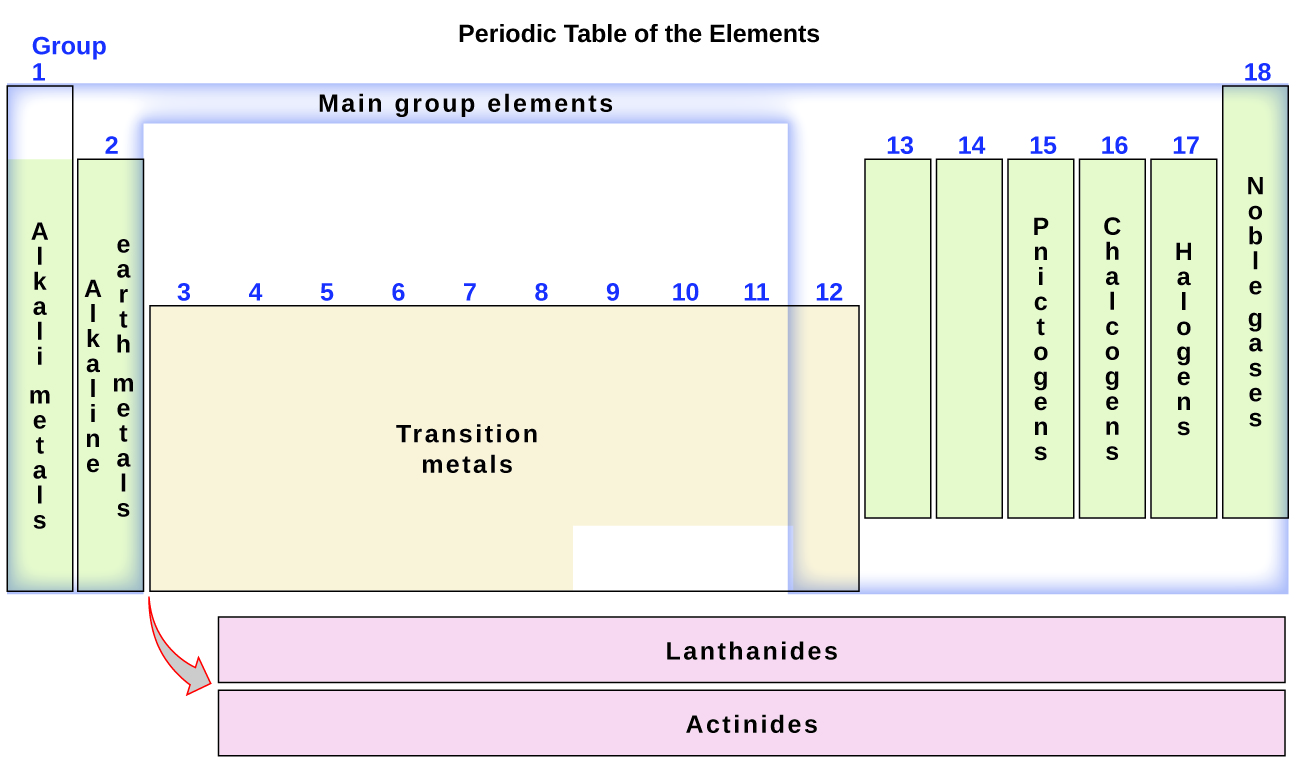
The elements can also be classified into the main-group elements (or representative elements) in the columns labeled ane, 2, and thirteen–18; the transition metals in the columns labeled 3–12; and inner transition metals in the ii rows at the bottom of the tabular array (the top-row elements are called lanthanides and the lesser-row elements are actinides; Effigy three). The elements tin be subdivided farther by more specific properties, such as the composition of the compounds they class. For example, the elements in group 1 (the first column) form compounds that consist of i atom of the chemical element and i atom of hydrogen. These elements (except hydrogen) are known every bit alkali metals, and they all have similar chemical properties. The elements in group 2 (the second column) form compounds consisting of one atom of the element and two atoms of hydrogen: These are called alkaline metal globe metals, with similar properties among members of that group. Other groups with specific names are the pnictogens (group 15), chalcogens (group 16), halogens (group 17), and the noble gases (group xviii, too known as inert gases). The groups tin also be referred to past the offset element of the grouping: For example, the chalcogens tin can be called the oxygen grouping or oxygen family unit. Hydrogen is a unique, nonmetallic element with properties similar to both grouping 1A and group 7A elements. For that reason, hydrogen may exist shown at the top of both groups, or by itself.

Click on this link for an interactive periodic table, which you lot tin utilise to explore the backdrop of the elements (includes podcasts and videos of each element). You may besides desire to attempt this one that shows photos of all the elements.
Case 1
Naming Groups of Elements
Atoms of each of the following elements are essential for life. Give the group proper name for the following elements:
(a) chlorine
(b) calcium
(c) sodium
(d) sulfur
Solution
The family names are as follows:
(a) element of group vii
(b) alkaline world metal
(c) alkaline
(d) chalcogen
Check Your Learning
Give the group proper noun for each of the post-obit elements:
(a) krypton
(b) selenium
(c) barium
(d) lithium
Answer:
(a) noble gas; (b) chalcogen; (c) element of group ii; (d) alkali metal
In studying the periodic table, you might have noticed something about the diminutive masses of some of the elements. Element 43 (technetium), chemical element 61 (promethium), and most of the elements with atomic number 84 (polonium) and higher have their atomic mass given in foursquare brackets. This is done for elements that consist entirely of unstable, radioactive isotopes (you will learn more almost radioactivity in the nuclear chemical science affiliate). An average atomic weight cannot be determined for these elements because their radioisotopes may vary significantly in relative abundance, depending on the source, or may not even exist in nature. The number in square brackets is the atomic mass number (and approximate diminutive mass) of the most stable isotope of that element.
Primal Concepts and Summary
The discovery of the periodic recurrence of like properties amid the elements led to the formulation of the periodic table, in which the elements are arranged in club of increasing atomic number in rows known as periods and columns known equally groups. Elements in the same grouping of the periodic tabular array accept like chemical backdrop. Elements tin can exist classified equally metals, metalloids, and nonmetals, or as a master-grouping elements, transition metals, and inner transition metals. Groups are numbered 1–18 from left to right. The elements in group ane are known as the alkali metals; those in group 2 are the alkaline earth metals; those in 15 are the pnictogens; those in xvi are the chalcogens; those in 17 are the halogens; and those in 18 are the noble gases.
Chemistry End of Affiliate Exercises
- Using the periodic tabular array, classify each of the following elements equally a metal or a nonmetal, and then further classify each as a main-group (representative) element, transition metal, or inner transition metal:
(a) uranium
(b) bromine
(c) strontium
(d) neon
(due east) gold
(f) americium
(g) rhodium
(h) sulfur
(i) carbon
(j) potassium
- Using the periodic table, allocate each of the post-obit elements equally a metal or a nonmetal, and so further classify each as a main-group (representative) element, transition element, or inner transition element:
(a) cobalt
(b) europium
(c) iodine
(d) indium
(e) lithium
(f) oxygen
(h) cadmium
(i) terbium
(j) rhenium
- Using the periodic tabular array, identify the lightest member of each of the following groups:
(a) noble gases
(b) alkaline earth metals
(c) alkali metals
(d) chalcogens
- Using the periodic tabular array, identify the heaviest member of each of the following groups:
(a) alkali metals
(b) chalcogens
(c) noble gases
(d) alkaline earth metals
- Use the periodic table to requite the name and symbol for each of the following elements:
(a) the noble gas in the same menses as germanium
(b) the alkaline earth metal in the same period as selenium
(c) the element of group vii in the same period every bit lithium
(d) the chalcogen in the aforementioned period every bit cadmium
- Use the periodic table to give the proper noun and symbol for each of the following elements:>
(a) the halogen in the aforementioned period as the alkali metal with 11 protons
(b) the alkaline world metallic in the same menstruation with the neutral noble gas with 18 electrons
(c) the element of group 0 in the aforementioned row equally an isotope with 30 neutrons and 25 protons
(d) the noble gas in the aforementioned period equally gilt
- Write a symbol for each of the following neutral isotopes. Include the atomic number and mass number for each.
(a) the brine metal with 11 protons and a mass number of 23
(b) the element of group 0 element with 75 neutrons in its nucleus and 54 electrons in the neutral atom
(c) the isotope with 33 protons and 40 neutrons in its nucleus
(d) the element of group i earth metal with 88 electrons and 138 neutrons
- Write a symbol for each of the post-obit neutral isotopes. Include the atomic number and mass number for each.
(a) the chalcogen with a mass number of 125
(b) the halogen whose longest-lived isotope is radioactive
(c) the element of group 0, used in lighting, with x electrons and ten neutrons
(d) the lightest alkali metal with three neutrons
Glossary
- actinide
- inner transition metal in the bottom of the bottom two rows of the periodic table
- alkali metal
- element in group 1
- element of group ii
- element in group 2
- chalcogen
- chemical element in group 16
- group
- vertical column of the periodic table
- element of group vii
- element in group 17
- inert gas
- (also, element of group 0) element in grouping 18
- inner transition element
- (also, lanthanide or actinide) element in the bottom ii rows; if in the first row, also called lanthanide, or if in the 2nd row, as well chosen actinide
- lanthanide
- inner transition metal in the top of the lesser 2 rows of the periodic table
- main-grouping element
- (too, representative chemical element) element in columns 1, 2, and 12–18
- metal
- element that is shiny, malleable, practiced conductor of heat and electricity
- metalloid
- element that conducts estrus and electricity moderately well, and possesses some properties of metals and some properties of nonmetals
- noble gas
- (also, inert gas) chemical element in group 18
- nonmetal
- element that appears dull, poor conductor of heat and electricity
- period
- (besides, series) horizontal row of the periodic tabular array
- periodic law
- backdrop of the elements are periodic function of their atomic numbers.
- periodic table
- table of the elements that places elements with like chemical properties shut together
- pnictogen
- chemical element in grouping 15
- representative element
- (also, master-grouping element) element in columns one, 2, and 12–eighteen
- series
- (as well, period) horizontal row of the period table
- transition metal
- element in columns iii–11
Solutions
Answers to Chemistry End of Chapter Exercises
ane. (a) metal, inner transition element; (b) nonmetal, representative element; (c) metal, representative element; (d) nonmetal, representative chemical element; (due east) metal, transition metallic; (f) metal, inner transition metallic; (g) metallic, transition metal; (h) nonmetal, representative element; (i) nonmetal, representative element; (j) metal, representative element
3. (a) He; (b) Exist; (c) Li; (d) O
5. (a) krypton, Kr; (b) calcium, Ca; (c) fluorine, F; (d) tellurium, Te
7. (a) [latex]_{11}^{23}\text{Na}[/latex]; (b) [latex]_{54}^{129}\text{Xe}[/latex]; (c) [latex]_{33}^{73}\text{As}[/latex] ; (d) [latex]_{88}^{226}\text{Ra}[/latex];
flemingmanotty1982.blogspot.com
Source: https://opentextbc.ca/chemistry/chapter/2-5-the-periodic-table/
0 Response to "What Determines the Properties of Each Family on the Periodic Table of Elements"
Enregistrer un commentaire