People Must Again Learn to Work Instead of Living on Public Assistance. - Cicero
As we've noted many times in these pages, one common fashion in which people attempt to demonstrate the aptness of a particular social or political viewpoint is to put its expression into the mouth of a revered historical figure.
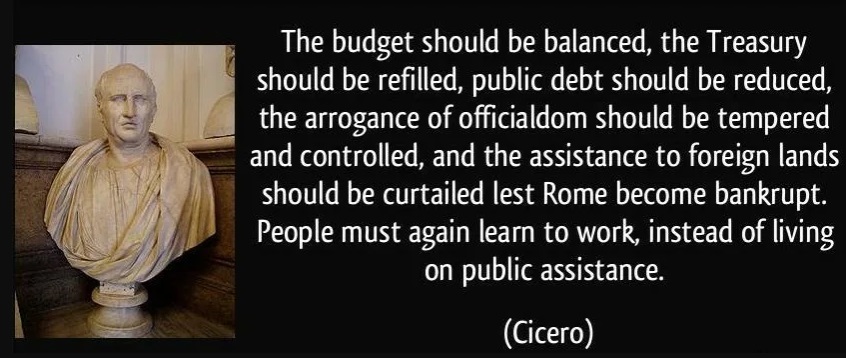
[Collected via e-mail, April 2008]
This quote is going around the cyberspace. I would like to know if it really came from Cicero as claimed.
"The upkeep should be balanced, the Treasury should be refilled, public debt should be reduced, the arrogance of officialdom should be tempered and controlled, and the assistance to foreign lands should be concise lest Rome go broke. People must once more learn to piece of work, instead of living on public assistance." — Cicero, 55 BC
Surely if ane of great minds of our civilization, someone who lived hundreds (or even thousands) of years ago, said the very same thing nosotros're thinking today, then surely that's proof we've hit upon some eternal truth that should be sagaciously heeded. In curt, attributing apocryphal quotations to everyone from Confucius to Abraham Lincoln is an attempt to capitalize on the saying that "neat minds call up akin."
One prime representative of this phenomenon is the passage reproduced to a higher place, which warns about the perils of governments' overspending their budgets and lavishing as well much money on foreign aid and welfare programs. For the last half century it has been attributed to Roman philosopher and statesman Marcus Tullius Cicero and widely quoted by politicians and pundits seeking to bolster their arguments in favor of fiscal conservatism. For case, Louisiana representative Otto Passman, who for thirty years "pursued a relentless battle against spending for foreign assist" in the U.Due south. Congress, read these words into the Congressional Record on April 25, 1968:
Mr. Speaker, the tape shows that in all ages where republican forms of regime have been lost, it has been through the pretense of a share-the-wealth plan, a blind religion in public officials, and apathy on the part of those who could act only did non. To mention merely ane of many, many examples from by history, may I quote from a argument made past Cicero over 2,000 years ago:
The budget should be balanced, the treasury should be refilled, public debt should exist reduced, the arrogance of officialdom should be tempered and controlled, and the assistance to strange lands should be curtailed lest Rome get bankrupt, the mobs should be forced to work and not depend on authorities for subsistence.
History reveals that public officials heeded non the warning — therefore, the government collapsed.
On March 29, 1971 the Chicago Tribune published a letter from a reader who invoked the same words to brand a similar point:
Someone said years ago: "The more things change, the more than they are the aforementioned."
Today'southward problems are not new. The Roman Empire faced bankruptcy 2,000 years ago, as more and more than ability was concentrated in primal regime and authorities spending grew.
Cicero spoke out against the trend. This great Roman senator said: "The budget should be balanced, the treasury should be refilled, public debt should be reduced, the arrogance of officialdom should be tempered and controlled, assist to foreign lands should be concise lest Rome become bankrupt. The mobs should be forced to work and non depend on regime for subsistence." Romans ignored Cicero; Rome roughshod.
History is great if we learn from it. It is not too late for the Us to heed those words out of the by.
Those words were never uttered by Cicero, withal; and the reason no one ever quoted them every bit such until near fifty years ago is because they weren't written until 1965. They sprang from the pen of Taylor Caldwell, a fiction writer best known for historical novels such as Captains and the Kings, her 1972 all-time-selling chronicle of the rise to wealth and power of an Irish gaelic immigrant named Joseph Francis Xavier Armagh (which was also fabricated into a popular television mini-series in 1976).
Caldwell penned several novels based on real-life religious and historical figures, including Genghis Khan (The Earth Is the Lord'southward), Fundamental Richelieu (The Arm and the Darkness), Saint Luke (Love and Glorious Medico), Saint Paul (Great Lion of God), Aspasia (Glory and the Lightning), and Judas Iscariot (I, Judas). Her 1965 effort A Pillar of Iron was a historical novel about the life of Cicero, the great Roman statesman who "is a pillar of iron as he publicly maintains his search for honour and justice nether law in the face up of plots confronting his life and his country."
Although A Pillar of Iron often drew directly from the recorded speeches and messages of Cicero for its dialogue, information technology was nonetheless a work of fiction, and the at present famous statement from Cicero about "balancing the budget" was an invention of Caldwell'due south and not a reproduction of Cicero's own words. In fact, the novel doesn't even present these words as something spoken past Cicero, but rather as a summation of Cicero's political philosophy presented as a preface to an imagined conversation between Cicero and Gaius Antonius Hybrida:
Reared in republican virtues, Cicero plant himself frequently confounded by Antonius. Antonius heartily agreed with him that the budget should exist balanced, that the Treasury should be refilled, that public debt should exist reduced, that the arrogance of the generals should be tempered and controlled, that assist to foreign lands should be curtailed lest Rome become bankrupt, that the mobs should exist forced to work and not depend on the government for subsistence, and that prudence and frugality should be put into practise as soon as possible. But when Cicero produced facts and figures how all these things must and should be accomplished, by austerity and discipline and commonsense, Antonius became troubled.
"But this — or that — would bring hardship on this — or that — class," Antonius said. "The people are accepted to lavish displays in the circuses and the theaters, and the lotteries, and free grain and beans and beef when they are destitute, and shelter when they are homeless and a part of the city is rebuilt. Is not the welfare of our people paramount?"
"There will be no welfare of the people if we become bankrupt," said Cicero, grimly. "We tin can become solvent again, and strong, only by self-denial and by spending as picayune as possible until the public debt is paid and the Treasury refilled."
"But one cannot — if one has a heart at all — deprive the people of what they have received for many decades from government, and which they wait. It will create the nigh terrible hardships."
"Better that all of u.s.a. tighten our girdles than Rome fall," said Cicero.
Every bit Jess Stearn observed in In Search of Taylor Caldwell, this imagined historical chat was reflective of Caldwell's ain political outlook much more than than Cicero's: "She was a conservative politically, believing the spoils belonged to those who toiled for them. There were not free lunches. She abhorred the welfare philosophy that gave handouts to complimentary-loaders, decrying rewards for indolence and incompetence." Or, as John Blundell aptly quipped in Ladies for Liberty, "Taylor Caldwell gives us financial policy, civil service reform, cuts in aid to less developed countries, and welfare reform all in i sentence."
The reproductions of Caldwell's words as a historical quote from Cicero take contradistinct the original a off-white fleck over the years: the admonition that "prudence and frugality should be put into practice as soon as possible" was quickly dropped from the end of the sentence; "people" accept replaced "mobs" as the ones who should be "forced to work and not depend on the government for subsistence"; the announcement that the "arrogance of the generals should be tempered and controlled" now refers to generic "officialdom" rather than armed services figures; and the warning that this advice demand be followed "lest Rome become broke" has mutated into the more ominous-sounding "lest Rome fall."
flemingmanotty1982.blogspot.com
Source: https://www.snopes.com/fact-check/taylor-made/
0 Response to "People Must Again Learn to Work Instead of Living on Public Assistance. - Cicero"
Enregistrer un commentaire