Which Scientist and Theories Has Been a Strong Advocate for the Connection Between Art and Science?
Image credit: Kurt Hickman
Hideo Mabuchi, professor of practical physics
Hideo Mabuchi grew up in a culture that values traditional craft and began collecting information technology himself during his travels. And so, although he began making ceramics on "a fleck of a whim," it was some other fashion of engaging with what he'd long appreciated. As for beingness a physicist to kicking, Mabuchi has ever had broad interests.
"I remember going to college thinking maybe I would do economics or aeronautical engineering science, and I had a menstruation of deep interest in linguistics and philosophy," he said. "In the finish, I actually liked the action and customs I found in physics."
Getting into woods-firing solidified Mabuchi's devotion to ceramics. Intrigued by the transformation of uniform, bare dirt into a riot of colors and textures, he has made many hundreds of woods-fired pieces, built his own blown-ash kiln on campus and studied the concrete and chemic process of wood-firing using electron microscopes at the Stanford Nano Shared Facilities. He has recently curated several displays at Stanford, including a gallery of his electron microscope images and an exhibition of East Asian ceramics. During his residency at the Haystack Mountain Schoolhouse of Craft ii years ago, Mabuchi started loom weaving. Some of his recent work combines clay and textiles.
For undergraduates, Mabuchi teaches a course on ceramics, physics and the creative process. He feels that education at this intersection is an opportunity for him to contemplate broader questions about "significant and pregnant-making," while also showing students that scientific discipline and art aren't mutually exclusive.
"It'south very natural to have interests both in artistic pursuits and in scientific ones," he said. "And information technology'south great for those of u.s. in the sciences, engineering, math who are interested in pursuing art to make ourselves visible to our students … to provide a role model of that and to give each other permission to do that."
Mabuchi is as well a fellow member of the Wu Tsai Neurosciences Found .
Image credit: Kurt Hickman
Kalanit Grill-Spector standing in front end of four of her paintings property a paint palette and paintbrush
Image credit: Fifty.A. Cicero
Kalanit Grill-Spector, professor of psychology
Painting and drawing were always a part of Kalanit Grill-Spector's childhood. But it wasn't until college, when she was looking for a mental escape from her engineering classes, that she began taking formal fine art classes. "I really enjoyed the intellectual function of engineering but I needed a more creative outlet," she said. She continued taking fine art classes throughout her undergraduate and graduate education.
With bold colors and thick lines, Grill-Spector paints vivid images of people, animals and scenes. She describes her art as expressionism. "I don't endeavour to be precise. It'due south more emotional and helps my mind both wander and concentrate," she said.
Grill-Spector was originally intent on becoming an engineer simply establish she was more interested in computations. She shifted her focus to computer vision, which then led her to neurobiology, where she concluded upward modeling the brain using her computer skills. Now, equally a cognitive neuroscientist, professor of psychology and member of the Wu Tsai Neurosciences Institute at Stanford and Stanford Bio-10, she studies how visual recognition works. "I think I accept a actually practiced visual agreement of things, and that's why I similar painting and why I like studying vision," she said.
Grill-Spector finds there is a clear relationship betwixt agreement art and beingness able to communicate science finer. "Having expert visuals actually helps convey ideas and information in a clear style – it's a actually good manner to become people to understand your idea," she explained. This is i of the reasons she incorporates an art project into the curriculum for her undergraduate class, Introduction to Perception. For their terminal consignment, students build or draw an illusion. Grill-Spector said she enjoys witnessing the creativity of her students and seeing how they chronicle fine art and scientific discipline. "They're both really creative processes," she said.
By Kimberly Hickok
Image credit: L.A. Cicero
Alice Lay sitting at a counter with her art supplies, various kitchen objects are in the foreground to the left
Epitome credit: L.A. Cicero
Alice Lay, graduate student in applied physics
Every bit a immature girl, Alice Lay would find ways to incorporate an chemical element of crafting into her class assignments. "I was always the one who would do more than than the teacher asked," she said. She in one case purchased an expensive woods burner just to create designs on an art piece she wanted to incorporate into her history grade project.
Lay returned to her artistic roots as an undergraduate at the University of California, Berkeley to brand personalized thank-yous cards for her professors. She enjoyed making the cards and then much that now, as a graduate student in Jennifer Dionne's lab, she continues the practice for members of her enquiry group – but she's taken it up a notch.
"Now, every bit I work on them, I go more and more crazy ideas like, I tin can make this flip up or this light up," she said. Recently she incorporated tiny electronic LED bulbs that light up on the carte du jour when y'all press three small buttons. For some other card, she wrote hidden messages in invisible ink.
While creating cards is her main creative medium, she enjoys finding artistic ways to make her scientific information more than visually appealing. "I discover that to be really nice because I can use my creative skills for my papers and my presentations, and be creative on that point," she said.
But crafting cards as well serves every bit an escape from her science career, she said. When experiments are failing and troubleshooting isn't working, she feels stuck and frustrated. "Just my cards are viable," she said. "The mechanics aren't very complicated then I feel like any I can think of is doable."
Every carte du jour she makes is unique to the person she'southward making it for. She includes things like an image of the person in a favorite outfit and references to inside jokes. "It'south e'er fun to incorporate those because I think it's so much more personal," she said. "And it's my way of thanking them for influencing my life."
By Kimberly Hickok
Prototype credit: Fifty.A. Cicero
Meredith Fields watercoloring
Image credit: Kurt Hickman
Meredith Fields, graduate student in chemic engineering
Similar many people, Meredith Fields was introduced to fine art equally a toddler. That was when she began drawing and working with watercolor – and she never stopped.
"Back when I was in schoolhouse, I was always known as the 'creative child' and it really wasn't until I got into college that I decided to even try science," said Fields, a graduate student in chemical engineering at Stanford, who added papercut art to her repertoire in high schoolhouse. "I wanted to do something that was practical merely also I wanted to take the one gamble I had at college to effort my hand at something technical and become qualified at that."
Fields's first internship was at NASA designing aerogels for the thermal protection of space probes and other instruments. She then worked on battery technologies. As role of the Nørskov lab at Stanford, she currently uses computational models to appraise the efficiency with which different catalysts assist chemical reactions.
Although Fields imagines possibly combining her fine art and her science in the future, she purposely engages in them separately for now.
"There have been phases of my life where I go in and out of fine art and, especially being a graduate pupil, information technology'south difficult to manage your time in a way where you lot tin can go on to pursue fine art," Fields said. "So, what art means to me has changed over time. Correct now, it'due south my stress release. It's my style of thinking in a way that's not math or equations."
Fields said that the more than she talks about her dual interests in art and science, the more she meets others who have similarly varied pursuits. Even for those who feel exclusively drawn to science, she encourages further exploration of art, believing that information technology touches anybody'south lives and there is something for anybody to appreciate in it.
Image credit: Kurt Hickman
Susan McConnell photographing a moose
Image credit: Tim Grams
Susan McConnell, professor of biology
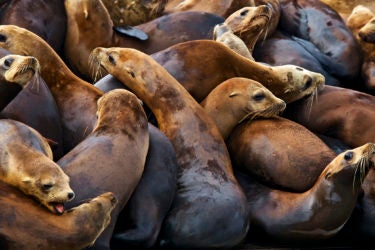
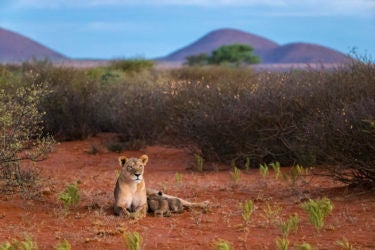
As a child, Susan McConnell remembers rifling through National Geographic at her grandparents' domicile and coming upon an commodity about Jane Goodall's chimpanzee research in Tanzania. Goodall's work looked exciting and exotic – and quite glamorous – and it opened up a world of possibilities for McConnell. "I became completely and romantically enamored with the thought of beingness out in Africa with wildlife," recalled McConnell, a professor of biology at Stanford University. "I'd e'er been an creature-crazy kid, and the idea that you lot could written report animals scientifically was what drew me into science." That commodity eventually led to two careers for McConnell: one equally a neurobiologist and another as a conservation lensman.
Her early efforts to study animal behavior in the laboratory led McConnell to focus on solving the fundamental mysteries of the genes and cellular mechanisms that form neural circuits, which are the underpinnings of all beliefs. She was more than tentative nearly pursuing photography until a moment in 2005, when she was photographing a polar bear jumping across water ice floes in the Arctic northward of Norway. Although she was freezing cold, she realized that information technology was the happiest she had ever been.
"In wildlife photography, in that location are often hours of just sitting and waiting. Then, all of the sudden, two, three herds of elephants come up to a watering hole and you have two cameras out and everything is happening," said McConnell. "Those moments where everything comes together, the moments that make an image really special, are very rare."
In addition to her biology classes, McConnell teaches an IntroSem on conservation photography and runs a year-long capstone project where seniors in the natural sciences express science through fine art. She was besides the showtime non-art kinesthesia member to have a show – on elephants and the ivory crunch – in the Stanford Fine art Gallery.
And, like Goodall, her work has been featured within the pages of National Geographic.
McConnell is as well a member of Bio-X and the Wu Tsai Neurosciences Institute.
Image credit: Tim Grams
Epitome credit: Susan McConnell

Epitome credit: Susan McConnell

Image credit: Susan McConnell
Epitome credit: Susan McConnell

Epitome credit: Susan McConnell
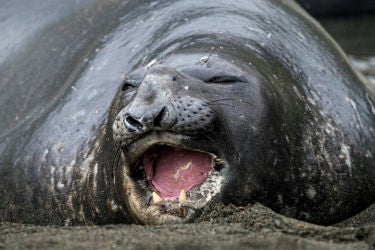
Image credit: Susan McConnell
Fullscreen
Vivian Wang and her art
Image credit: L.A. Cicero
Vivian Wang, BS '17, electrical applied science
Although Vivian Wang has long enjoyed making art in her free time, she nearly missed her chance to accept advantage of Stanford's fine art course offerings. "I felt like I'd been taking besides many engineering and math classes, so I decided I should accept at least one art course earlier I graduated!" she said. She took a digital printmaking course, and has since had work from that course accepted to the Bridge conference, an international effort to highlight math within other disciplines. Previously, Wang'south beaded art sculptures were featured in the 2015 and 2016 conferences.
One of the pieces featured a latticed, curving combination of two prints depicting famous mathematicians. From one side, yous see the face of David Hilbert – from the other, that of Wacław Sierpiński. The class of Wang's Faces of Hilbert and Sierpiński could serve as an analogy for her dear of both science and art. These passions sometimes overlap. Simply even when they don't, they strike a certain harmony. "My art isn't always necessarily a visualization of science, but it's a skill that is very complementary to what I do in the sciences," Wang said.
In both fine art and science, she finds joy in experimentation. She sees research as an opportunity to unearth, shape and reshape cognition through discovery and analysis, while fine art offers her restorative lessons in embracing mistakes and disorder.
As a recipient of the Churchill Scholarship, Wang is working on a master's of philosophy degree in physics at the Academy of Cambridge. After that, she plans to render to the United States to earn a doctorate in electrical engineering. Wang besides thinks she'll go on exploring new art forms, and is already experimenting with pottery and sketching.
Image credit: Fifty.A. Cicero
Parag Mallick performing
Image credit: Kurt Hickman
Parag Mallick, associate professor of radiology at the Stanford Academy Schoolhouse of Medicine
Parag Mallick's honey for magic started with simple toys, the kind y'all tin purchase at a convenience store. He so picked up juggling in college, which he calls "a gateway drug to the circus arts." Through lessons at the legendary Magic Castle during graduate school in Los Angeles, Mallick adult his skills as professional performer.
And he was doing all of this while working toward becoming an astronaut.
"I got into my specific surface area of research because I wanted to empathize how human physiology works and, in item, what happens to people on the ground and in space," said Mallick, now an associate professor of radiology at the Stanford University School of Medicine, focusing on systems biology, personalized medicine and cancer diagnostics. "Beingness a Stanford professor was kind of my redundancy plan."
For years, Mallick kept his two worlds completely split up, concerned that other performers would question his dedication to his craft and that scientists wouldn't have him – or his research – seriously. Information technology'south only recently that he'southward unified his dual life. The alter has been overwhelmingly positive. "Being able to talk about magic openly and being able to discuss concepts from magic in scientific discipline – like the fundamentals of perception and misperception and how that might influence our ability to draw conclusions from data – I think information technology's really fabricated me both a better scientist and a better magician," he said.
Close-up magic, similar the 3 Card Monte trick, are Mallick's specialty. He loves the intimate, shared experience of these performances and their dependence on meticulousness, a talent he applies to his science and his art. Both passions have also refined Mallick's skills as storyteller, communicator and performer. Whether he's juggling machetes or teaching his students about bioinformatics, Mallick hopes to encourage people to try out new perspectives and embrace their sense of wonder.
Mallick is a member of The Canary Center @ Stanford for Cancer Early Detection , Stanford Bio-X , the Stanford Cancer Institute and a faculty fellow of Stanford ChEM-H.
Prototype credit: Kurt Hickman
Stephanie Fischer composing
(Image credit: Fifty.A. Cicero)
Stephanie Fischer, BS '18, World systems; BA 'eighteen, music composition
Stephanie Fischer has been singing for longer than she tin recollect. "Even earlier I could talk, I was singing something in some kind of language," she said.
A veteran of the stage, she considered minoring in performance at Stanford but fell in dear with the challenges and opportunities of composition. "It's a new way to articulate my ideas through a medium that's different from speaking with someone or performing someone else's music," she said. "It'd also be lovely to exist an example that other people who look like me, women and people of color, can compose if they want to."
Fischer too pursued Earth systems studies before Stanford. She was originally involved in paleoclimatology research but her interests shifted when, in 2012, Superstorm Sandy destroyed much of her family's dwelling in Long Island.
"That experience reminded me that changes in the climate are not confined to a thousand years ago, that these processes that cause mass extinctions aren't something that'southward removed from the present day," Fischer said. "It's something that tin happen now and in a very personal fashion … just similar how it affected my family, as well as many other families."
As an Earth systems major, Fischer focused on man experience and how those narratives, particularly those of low-income communities and communities of color, are oftentimes ignored in Earth systems enquiry.
People often ask Fischer how she "switches brains" between the arts and the sciences – a concept she once believed. "It was a lilliputian difficult going through the day, feeling similar I was bouncing between two minds," she said. "It got meliorate one time I realized that there'due south no concrete split up. Information technology's just a different mode to look at the same thing, and together you lot get a more nuanced approach to solving problems."
(Epitome credit: Fifty.A. Cicero)
2016-17 Stanford Chinese Dance
Image credit: Hai Yan Jackson
Annie Hu, BS '17, biology
Karen Huynh, BS 'eighteen electric engineering
Ariel Liu, '19, major in product design
Unlike nigh trip the light fantastic toe groups at Stanford, Chinese Dance requires no prior experience, no auditions. That is what drew Annie Hu, Karen Huynh and Ariel Lu to the troupe. "Growing upwards, I never had the chance to be involved in trip the light fantastic toe or whatsoever Chinese cultural activities," Huynh said. "It was an opportunity to connect to my civilisation and larn more about trip the light fantastic toe."
Hu, Huynh and Liu were the leaders of the 2016-2017 Chinese Dance group. Hu has long been interested in microbiology and immunology, enthralled past the complex actions and reactions of microscopic organisms in the human body. Huynh go an electrical engineering major after learning about climate alter and renewable free energy in a Sophomore College class. Liu intended to major in biological science only switched to product design after taking a mechanical engineering class on visual thinking. "I really like the mindset product designers take: using blueprint thinking and engineering science methods to suspension downwards the problems they face," Liu said. "Information technology's actually inspiring to call up that yous can do most annihilation if you lot break it down."
For all three, dancing is an opportunity to learn most and experiment with physical expression. It'due south also a stress reliever. "At that place's this stark difference between studying from a textbook and the creativity that comes with dancing and actually using your trunk," said Hu. "Past the end of practice, I'm then focused on the choreography and my body that it takes my mind off other worries."
The close bonds formed among these teams is some other perk that keeps students eager to meet up and work on their fine art. Hu, Huynh and Liu all program to pursue careers in their majors but they also hope to continue dancing fifty-fifty after they exit Stanford.
Image credit: Hai Yan Jackson
Riley Suhar
Image credit: Riley Suhar
Riley Suhar, graduate student in materials science
For Riley Suhar, a graduate student at Stanford University, science and fine art are complementary pairs, rooted in the pursuit of understanding and connection betwixt people.
"Scientific discipline and art are linked for me in that they represent means to frame the world and share that – in a very existent way – with those around me, whether aesthetically or translationally," she said.
Working in digital painting, photography and graphite, much of her inspiration comes from gaming fine art. From a young age she was mesmerized with how the art in games could build stories, stir emotions and establish entire universes through clever manipulations of light and color. Of her own work, Suhar's favorite pieces are those that reach out to the viewer in a gripping, often emotional way.
"What I find so compelling nigh artwork is that it is a fashion for me to condense a lot of the things that I find cute or moving and share those with others," Suhar said.
As an undergraduate, she worked on metallic alloys and hoped to eventually apply that to avant-garde prosthetics in graduate school. Simply, told she was lacking the proper biomaterials background, she most gave up. Suhar was readying herself for a Peace Corps assignment in Zambia when the Heilshorn lab at Stanford invited her to join. Suhar is now working on a project where she leverages recombinant proteins to aid with peripheral nerve repair.
"For me, studying science and performing enquiry is no different than learning another language in that information technology enables to me communicate with more people – with the added benefit of being able to work on projects that may go to helping someone, somewhere," she said.
Image credit: Riley Suhar
flemingmanotty1982.blogspot.com
Source: https://news.stanford.edu/2019/01/30/science-meets-art/
0 Response to "Which Scientist and Theories Has Been a Strong Advocate for the Connection Between Art and Science?"
Enregistrer un commentaire